

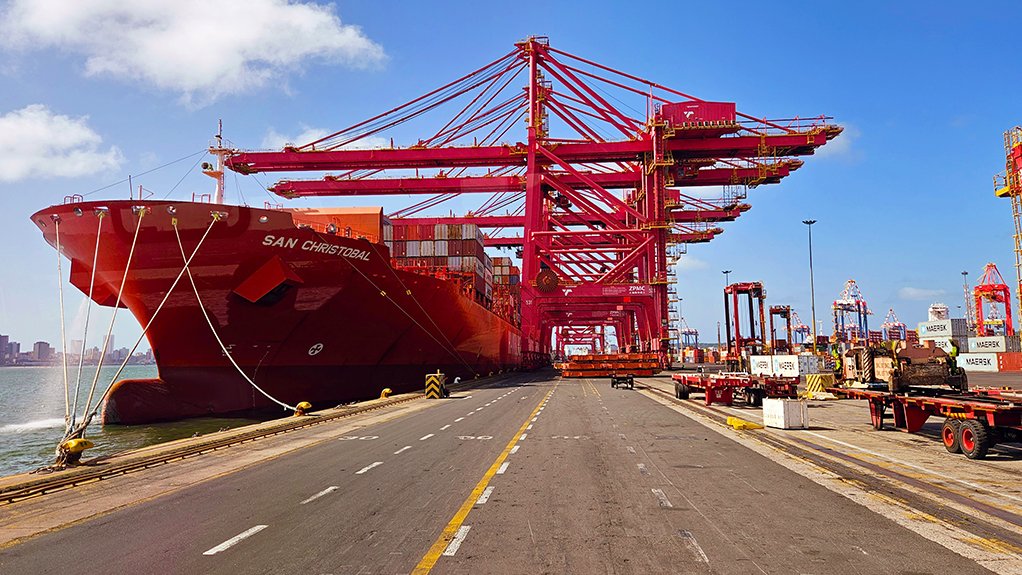

South African agricultural exporters are facing steep financial pressure as major shipping lines roll out significant cost recovery price hikes. This development follows a new Fuel Neutrality Charge implemented by Transnet Port Terminals to offset volatile global energy prices.
Because local container terminals heavily rely on diesel powered machinery to move fruit, grain, and livestock containers, surging fuel costs have directly impacted logistics operations. Rather than absorbing these expenses, ocean carriers are passing the terminal fees directly down to the cargo owners.
According to Transnet Port Terminals General Manager for Commercial and Planning, Michelle van Buren Schele, the newly introduced fuel charge functions strictly as a transparent, cost-recovery mechanism rather than a profit-generating measure.
Chronology of the Port Price Escalation
The cost adjustments hit the agricultural supply chain in rapid stages over the winter season, driven directly by severe domestic fuel volatility.
Mid-April 2026: Transnet announced a short term cost recovery mechanism following a massive jump in coastal diesel prices, driven by the blockade of the Strait of Hormuz. Transnet officials later confirmed that local coastal diesel costs had spiked by between R13.26 and R13.43 per litre since March 2026 due to these ongoing global supply chain disruptions.
1 May 2026: The Fuel Neutrality Charge officially came into action, charging a baseline fee of R52 per container.
14 May 2026: As local coastal diesel reached R30.30 per litre, Transnet announced the activation of a higher threshold tier within its operational cost matrix.
1 June 2026: The escalated fee of R78 per container took effect for all vessels berthing at national ports.
15 June 2026: Major shipping lines modified their tariff frameworks. Maersk implemented higher Port Additional Export and Port Additional Import charges on non-regulated trade lanes, effectively raising their local terminal dues by 50 percent to match the R78 terminal fee.
15 July 2026: The higher container surcharges will officially expand to include regulated global trade lanes, such as United States routes, as well as export shipments originating from Brazil and South Korea, following the completion of mandatory legal notice periods.
Agricultural Input Pressures Mount
The port surcharge arrives at a difficult moment for commercial and emerging farming businesses preparing for the upcoming production season.
Agricultural Business Chamber of South Africa Chief Economist Wandile Sihlobo recently pointed out that the industry is heavily exposed to these global disruptions. In his analysis, fertilizer prices have escalated by roughly 50 percent compared to last year, with fertilizer and fuel combined accounting for a vast portion of a grain or field crop farmer total input expenses.
With production margins already under severe pressure, added logistical penalties at the ports create an immediate financial headwind for high value agricultural exports like citrus, apples, and table grapes.
Mechanisms for Potential Tariff Relief
There is a distinct silver lining for the agricultural sector. The port surcharge is not a permanent tariff adjustment. Michelle van Buren Schele explicitly confirmed that the fuel neutrality charge is “short term in nature” and will only be applied by the port authority during periods of extreme fuel price variation. It functions as a floating index that is reassessed on a monthly basis based on actual coastal diesel index data.
Recent breakthrough news regarding an agreement to reopen the Strait of Hormuz is expected to expand global energy supplies. Wandile Sihlobo noted that if this geopolitical resolution holds, the agricultural sector can expect some welcome easing in input and logistics costs ahead of the mid-October summer planting season.
If local coastal diesel costs drop below R27.00 per litre, Transnet is structurally mandated to reduce the port charge from R78 back to R52. Should fuel baselines drop below R20.00 per litre, the fee reduces to R0. Because shipping line surcharges are pegged directly to the Transnet baseline, exporters will see their freight invoices adjust downward the moment fuel markets cool.