

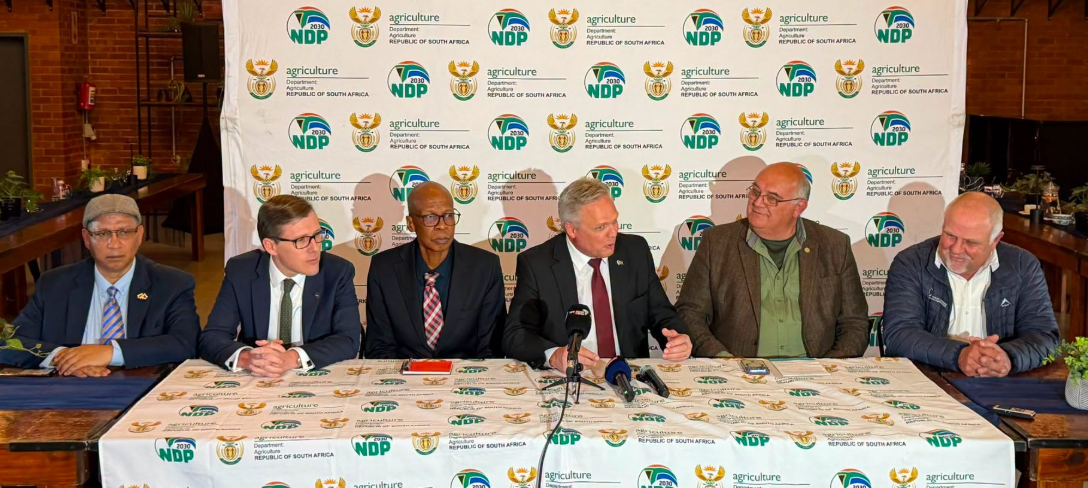

South African agriculture has entered a new era now that the long-running and destructive standoff over the control of the country’s biosecurity is officially over. On July 9, 2026, a historic out-of-court settlement was reached in Pretoria between the National Department of Agriculture and a unified private sector front consisting of Free State Agriculture (Vrystaat Landbou), Saai, and Sakeliga.
The legal battle initially culminated in a landmark High Court order ruling in the farmers’ favour, establishing that the state’s centralist monopoly over Foot and Mouth Disease (FMD) vaccine procurement had no valid defense.
This decisive breakthrough comes during Minister Willie Aucamp’s mere second week in office, having assumed the agriculture portfolio on 1 July. Rather than retreating behind protracted legal warfare, Minister Aucamp used his first ten days to dismantle the state’s restrictive gatekeeping, transforming the ministry into an economic enabler.
Breaking the Stumbling Blocks
By signing the agreement, the Department of Agriculture and Onderstepoort Biological Products (OBP) expressly relinquished their sole rights to the import and distribution of FMD vaccines. Speaking after the briefing, Minister Aucamp underscored the economic reality behind his decision:
“Today’s settlement is not only a win for the parties involved in the case but is a win for all South African farmers as this sector contributes significantly to the country’s job creation efforts and GDP.”
The Minister directly acknowledged that the state could no longer fight this biosecurity war alone, stating there is absolutely no way the government on its own could solve the foot-and-mouth crisis without opening the market to fair competition.
From Bureaucracy to Logistics
With the legal warfare brought to a close, the focus shifts entirely from courtroom strategy to rapid operational execution. Dr. Theo de Jager, Chairperson of Saai, remarked that in his entire lifetime in organized agriculture, he had never seen this kind of principle-driven leadership displayed by the state.
De Jager noted that, “The state wants to be an enabler, not a stumbling block… breaking the walls.” However, he pointed out that the immediate challenge is now a logistical one. With the monopoly broken, the priority must be supply chain speed: “Get the shortest route between the harbour and the cattle.”
Sakeliga strongly echoed this sentiment, welcoming the practical resolution to the intense legal proceedings. The group expressed great satisfaction with what they deemed a “good settlement to the legal proceedings [enabling] farmers to vaccinate their cattle [and] obtain the vaccines,” wishing the farming community well as they move forward to actively manage the disease.
A Vision for Production and Partnership
Western Cape Provincial Minister of Agriculture Dr. Ivan Meyer praised the historic moment as a true triumph for the rule of law. He shared a refreshing, direct quote from his new national counterpart that sets the tone for the future:
“Farmers must not be in court, they must be on the farm.”
Dr. Meyer highlighted that Minister Aucamp was driven to settle by a distinct, three-part vision: clearing paralyzing litigation to refocus on boosting production, honouring the commitment of local farmers to grow their contribution to the national GDP, and achieving those targets through genuine public-private cooperation. “Ons begin vandag op ’n nuwe bladsy en bou die land,” Meyer added.
A Shared Responsibility
This historic settlement is explicitly not a matter of “winners and losers.” As Vrystaat Landbou summarized, the only true winners are the farmers. Yet, this newly won autonomy brings a massive weight of national responsibility.
Organized agricultural leadership was unanimous in its ultimate warning to the countryside: farmers must play by the rules. To utilize the parallel tracks, livestock owners must strictly adhere to all biosecurity prescripts, officially register as authorized persons, and maintain absolute standards in reporting and traceability.
By trusting the private sector, a decisive new ministry has finally given farmers the structural tools to defend their own livelihoods. Now, it is up to the agricultural community to take up that responsibility, work seamlessly with the state, and build the sector forward.