

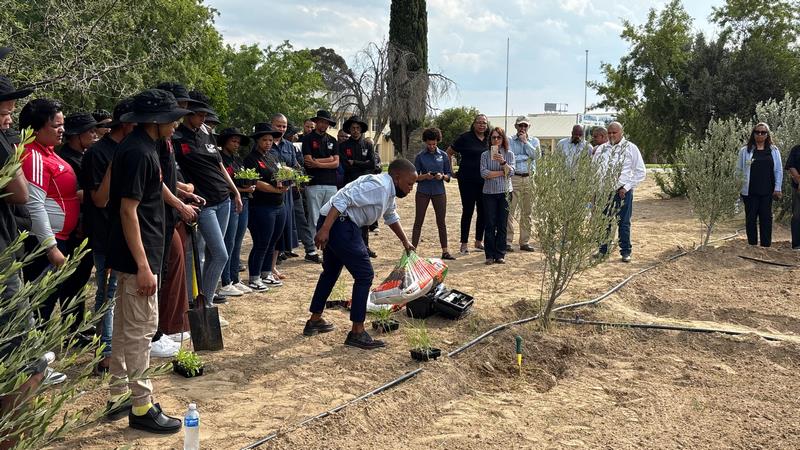

The Brandvalley and Rietkloof Wind Farm Community Roots Project has officially transitioned from launch to action across the Central Karoo. Spearheaded by the Wildlife and Environment Society of South Africa (WESSA) in partnership with renewable energy developer Red Rocket, the initiative is equipping local youth with accredited training in climate-smart agriculture, agribusiness, and environmental stewardship.
By establishing community “Eco-Hubs” at key sites like Laingsburg High School, as well as in Sutherland and Matjiesfontein, the project directly links renewable energy socio-economic development with resilient farming practices tailored to South Africa’s arid regions.
Bridging Renewable Energy and Arid Farming
In the Central Karoo, low annual rainfall, extreme temperatures, and poor soil nutrient retention present formidable hurdles to traditional farming. The Community Roots Project addresses these environmental realities head-on by providing 15 unemployed young people with specialized, water-wise agricultural training.
Rather than relying on high-input agricultural models, the program focuses on practical, low-cost climate adaptation:
Water Efficiency: Rainwater harvesting and optimized irrigation scheduling to stretch scarce water resources.
Soil Regeneration: Mulching and composting to boost organic matter and retain soil moisture.
Drought-Tolerant Crops: Strategic selection of crop varieties suited specifically to local Karoo soil and weather conditions.
For Red Rocket, funding the project through its Brandvalley and Rietkloof Wind Farms creates a direct connection between clean energy investment and long-term agricultural sustainability in host communities.
Building Agribusiness from the Ground Up
The initiative’s central operational unit—the “Eco-Hub”—is structured not merely as a training facility, but as an active launchpad for local enterprise. By pairing practical food garden management with entrepreneurship, the program enables participants to transform small plots into sustainable micro-enterprises.
“An Eco-Hub is a group of young people working together towards a common goal. It is not a school or simply a training unit; it is young people coming together to address challenges such as unemployment and substance abuse, while building skills and opportunities through sustainable food gardens,” explains Sinoxolo Sabelo, WESSA’s Community Roots Project Coordinator.
Local Ownership for Long-Term Impact
Grounded in an extensive baseline process conducted in late 2025 using the Sustainable Livelihoods and Vulnerability Framework—and validated with residents in early 2026—the project prioritizes co-creation over top-down intervention. In her keynote address, Mayor of Laingsburg Aletta Theron stressed that long-term success depends on local buy-in.
“To the beneficiaries and members of our community, this project belongs to you,” Mayor Theron stated. “I encourage you to participate fully, take ownership of the opportunities presented and help ensure that the benefits of this initiative are sustained for years to come.”
Saai Karoo Landboufees Bring Innovasie, Tradisie en Gemeenskap na Laingsburg
A Blueprint for Sustainable Rural Futures
Ultimately, the Community Roots Project proves that renewable energy investment and sustainable agriculture do not have to operate in silos. By placing climate-smart agricultural tools directly into the hands of local Karoo youth, WESSA and Red Rocket are tackling youth unemployment and climate vulnerability at the same time.
As these Eco-Hubs mature, they offer far more than localized food gardens—they serve as a practical blueprint for how dryland farming communities across Southern Africa can turn environmental constraints into catalyst opportunities for green enterprise, self-reliance, and long-term food security.