

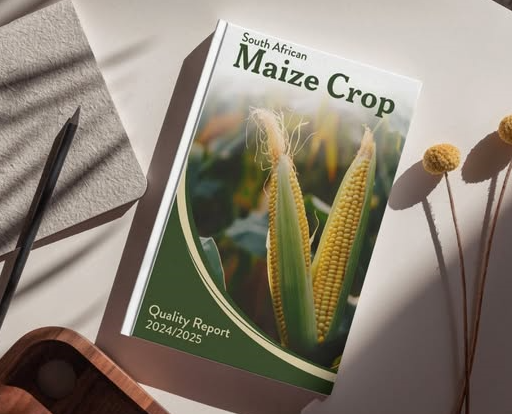

South Africa’s commercial maize crop for the 2024/25 season reached 16,650,000 tons, marking the second-largest crop on record behind the 2016/17 peak. This output represents a nearly 24% increase over the 10-year average of 13,470,350 tons. White maize accounted for 8,450,000 tons (50.8%), while yellow maize comprised 8,200,000 tons (49.2%). Total planted area was 2,596,700 hectares, a 1.5% year-on-year drop. However, overall yield increased by almost 32% over the previous season to 6.41 tons per hectare (t/ha)—well above the 10-year average of 5.33 t/ha. Yields averaged 5.28 t/ha for white maize and 8.22 t/ha for yellow maize.
Provincial Breakdown
Three key provinces contributed 81.9% of the total commercial crop:
Free State: Produced 6,870,900 tons on 1,195,000 ha (yield: 5.75 t/ha), with white maize comprising 63% of its production.
Mpumalanga: Harvested 4,080,000 tons across 524,000 ha (yield: 7.79 t/ha), dominated by yellow maize at 73%.
North West: Generated 2,690,850 tons on 540,000 ha (yield: 4.98 t/ha), primarily white maize (82%).
The non-commercial sector added an estimated 621,500 tons across 358,000 hectares, with the Eastern Cape producing the largest share (46.75%).
Local Processing & Foreign Trade
Local Processing: Total local maize processing reached 11,802,712 tons. White maize processing grew 11% year-on-year to 5,453,151 tons (90% for human consumption). Yellow maize processing fell 4.5% to 6,349,561 tons (89% allocated to animal feed and industrial uses).
Imports: South Africa imported 110,448 tons of yellow maize—a 72% drop relative to the 10-year average—sourced exclusively from Argentina for domestic use.
Exports: Whole white maize exports totaled 1,180,747 tons (90% to neighboring countries like Zimbabwe). Whole yellow maize exports rose nearly 12% to 872,840 tons (primarily to Zimbabwe and Eswatini).
Ending Stocks: Closing stocks as of April 30, 2025, rose sharply. White maize stocks reached 1,937,498 tons, while yellow maize stocks totaled 988,289 tons.
Crop Quality Testing & Laboratory Framework
The Southern African Grain Laboratory NPC (SAGL) evaluated 1,000 composite samples (458 white, 542 yellow) across production regions. Quality evaluation covered:
Grading Standards: Physical grading under RSA regulations and USA grading metrics.
Physical & Milling Attributes: Test weight (kg/hl), kernel size, stress cracks, 100-kernel mass, Bühler and Roff millings, and Whiteness Index (WI) for white maize meal.
Nutritional & Safety Profiling: Analysis of protein, fat, starch, fiber, and moisture alongside mycotoxin testing across 350 representative samples.
Strategic Relevance Today
Regional Food Security & Inflation Control: Ending stocks—reaching over 1.9 million tons of white maize and nearly 1 million tons of yellow maize—provide a crucial buffer against staple food price spikes and regional grain shortfalls. High export volumes continue to support neighboring markets in Sub-Saharan Africa.
Operational Benchmarks: The yield jump to 6.41 t/ha serves as a key baseline for seed selection, farm input strategy, and climate-resilience modeling. Provincial yield comparisons guide regional precision agriculture and irrigation planning.
Trade & Milling Optimization: SAGL quality verification (test weight, nutritional composition, and mycotoxin safety) gives international buyers confidence and enables local millers to optimize extraction rates, lower energy costs, and maintain food safety compliance.
AgriSA and ISS Join Forces to Drive Evidence-Based Rural Safety
The 2024/25 South African Commercial Maize Crop Quality & Production Report demonstrates a strong recovery in agricultural productivity and market stability. With production rising nearly 24% above the 10-year average and average yields climbing to 6.41 t/ha, South Africa reaffirmed its role as the dominant grain hub in Southern Africa. The combination of expanded volume, robust ending stocks, and comprehensive laboratory verification through SAGL ensures the supply chain meets both national milling criteria and regional food security demands.
To download the complete 2024/25 South African Commercial Maize Crop Quality & Production Report, including full laboratory datasets and regional grade tables, visit the official SAGL Maize Reports Portal.