

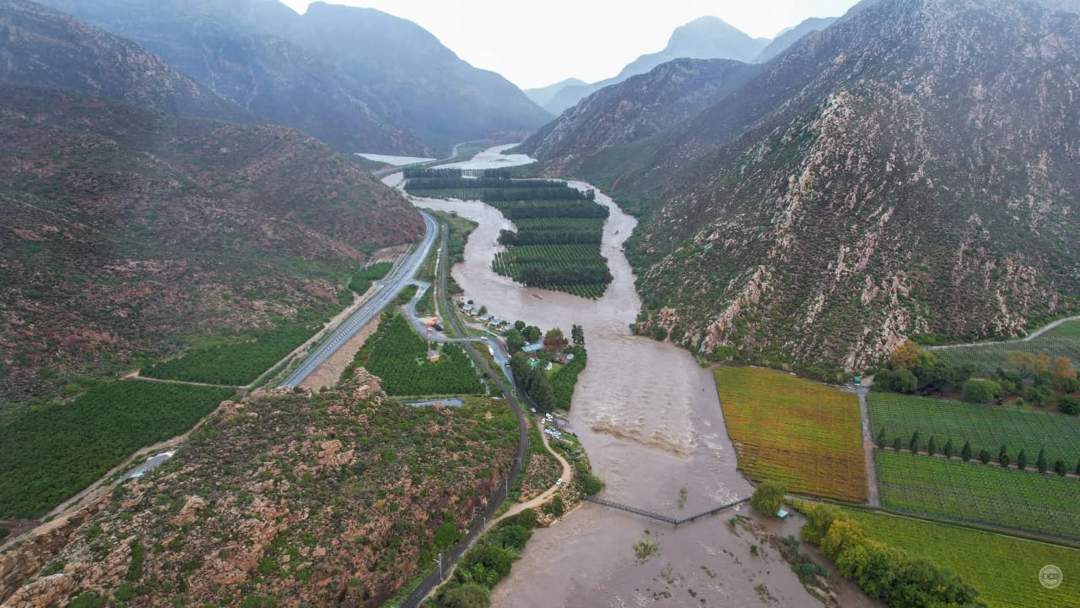

The Western Cape has moved from one climate extreme to another with breathtaking speed. On 1 May 2026, the province was warned of a dry winter ahead with dams at worrying levels; by 11 May, the provincial cabinet was welcoming a national disaster classification. This transition from scarcity to catastrophic surplus has left the agriculturalN sector with no time to pivot.
The Logistics Crisis: A Graveyard of Infrastructure
The most visible sign of the catastrophe remains the N1 corridor between Rawsonville and Paarl. In a major breakthrough following overnight work by SANRAL, Premier Alan Winde confirmed on 14 May that the N1 is now open in both directions, though it remains under strict traffic control. Authorities have implemented a scheduled rotation to manage the flow: traffic currently moves Southbound (Worcester to Paarl) from 06:00 to 09:00, and Northbound from 09:00 to 12:00.
Despite this reopening, the route remains a “bottlenecked flow” with heavy delays expected throughout the day. Furthermore, all vehicles carrying hazardous materials are strictly prohibited from the Huguenot Tunnel at this stage and must utilize the Du Toitskloof Pass. Drivers are urged to exercise extreme caution as water is still crossing the road in some areas.
Near Worcester, the force of the Breede River previously undermined the roadbed, uprooting massive slabs of tar like broken tectonic plates. Western Cape Minister of Infrastructure, Tertuis Simmers, confirmed that the department is in “full recovery mode,” prioritizing these “economic arteries.” However, the damage elsewhere is widespread. In the Klein Karoo, the N12 through Meiringspoort is closed indefinitely, forcing excessive detours through the R341 and N9, adding hundreds of kilometres and massive fuel costs to every delivery.
The Breede Valley: A Region Divided
The Breede River Valley has borne the brunt of the structural devastation. As the river surged to record levels, it transformed from a life-giving resource into a destructive barrier. In a dramatic rescue between Worcester and Rawsonville, NSRI teams spent Tuesday night evacuating 23 farm workers—including babies and the elderly—from rooftops after they were stranded by rising waters along the “Old N1.” Tragically, three lives were lost in the area.
The town of Worcester was effectively cut off this week as the N1, R43 (to Wolseley), R46 (to Villiersdorp), and R60 (to Robertson) were all shut down. The critical Nekkies Bridge remains a focal point of concern, while in Wolseley, the Klein Berg River burst its banks, submerging vineyards and displacing nearly 600 people into community halls.
Devastation on the Riverbanks
The most heartbreaking losses are found in the orchards and vineyards on the riverbanks. In the Hex River Valley, growers describe “the most water ever seen,” as the surging river reclaimed its natural floodplain.
Infrastructure & Homesteads: In the Goudini and Louwshoek areas near Rawsonville, historic farm homesteads and worker villages have been decimated. Some houses were physically washed away, while others are filled with meters of river silt.
The Olifants River Surge: Following the opening of the Clanwilliam Dam sluices yesterday, 12 May, a wall of water hit Vredendal and Klawer. The R363 river-level road has been severed, and many riverbank vineyards are currently submerged.
Witzenberg and Ceres: Isolated by rockfalls in Michell’s Pass and near-total power outages, these pome fruit hubs are struggling to maintain cold-chain integrity while communication remains intermittent.
Crop Outlook: A Race Against Rot
The timing has created a phytosanitary nightmare for the citrus industry. In the Cederberg and West Coast, orchards are too sodden for heavy machinery, closing the narrow window to treat for brown rot. While the apple harvest in Grabouw was largely complete, high-value late cultivars like Pink Lady suffered significant “fruit drop” due to 120km/h winds.
As the flood peak moves toward the lower Breede and Olifants systems, the Western Cape Department of Agriculture has begun a formal assessment. For now, the focus remains on the humanitarian crisis, as thousands of displaced farmworkers seek shelter while the province begins the long, expensive road to recovery.