

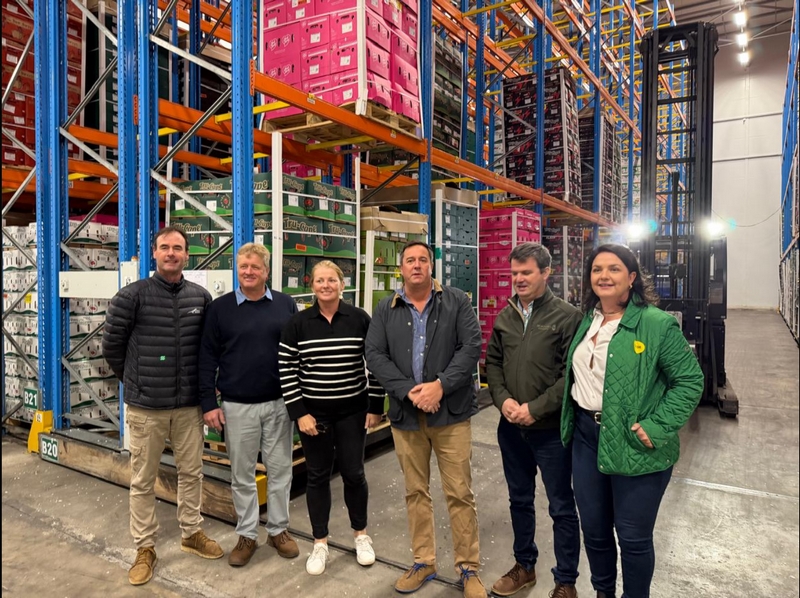

A catastrophic weather system that battered the Western Cape between 10 and 12 May has left the Witzenberg region facing a dual crisis of infrastructure destruction and a crippled electricity supply. With the regional fruit export industry hanging in the balance, National Minister of Agriculture John Steenhuisen visited the Ceres region on 18 May to assess the impact on the apple and pear industry and surrounding communities.
The most pressing threat stems from the collapse of six to ten critical electricity pylons in the Waaihoek area between Wolseley and Worcester. The collapse has slashed the region’s power supply to a mere 15% to 20% of its normal capacity. With repairs estimated to take up to four weeks, industry stakeholders warn that the financial and operational fallout could be immense.
Cold Storage and Jobs At Risk
Pieter Graaff, chairman of Tru-Cape Fruit Marketing—who along with Jacques du Preez of Hortgro accompanied Steenhuisen on an aerial site visit—revealed the staggering scale of the immediate crisis. There are over 300,000 tonnes of freshly harvested export fruit currently sitting in cold storage, entirely dependent on electricity to maintain market quality.
“There is insufficient generator capacity to keep these cold stores operational, while diesel costs are placing enormous financial pressure on businesses,” Graaff warned. “If the fruit deteriorates, it cannot be packed, which could result in thousands of job losses and major export revenue losses.”
Furthermore, Ceres Fruit Processors must still process more than 100,000 tonnes of apples and pears into concentrate while relying on costly generator power. Francois Malan, managing director at Ceres Fruit Growers, noted that millions of rands are being spent daily on diesel to keep packhouses, farms, and communities functioning.
Malan reported that Ceres received 488 mm of rain over the three-day period, while parts of the Witzenberg Valley recorded over 600 mm.
Damage Beyond Ceres
The devastation extended into the Elgin, Grabouw, Villiersdorp, and Vyeboom (EGVV) regions. Attie van Zyl, managing director at Two-a-Day, reported that approximately one-third of the fruit remaining on the trees was blown off by the wind and will now be diverted for juice. On a positive note, the rain brought a significant rise in the level of the Theewaterskloof Dam.
Government Commits to Urgent Action
Following his site assessment and meetings with Witzenberg Municipality Executive Mayor Councillor Trevor Abrahams and local agricultural directors, Minister Steenhuisen praised the resilience of the community and pledged intervention.
Steenhuisen emphasized that one-third of South Africa’s apple industry is based in Ceres, noting that the disastrous floods damaged parts of both the Western and Eastern Cape. He pointed directly to the fallen electricity pylons and road blockages as critical bottlenecks.
“Help is on the way,” Steenhuisen promised. “We need to focus on roads to make sure that the Mitchells Pass and some of the other roads there [are addressed]… We need to be able to get our trucks to the ports. These type of disasters is really the last thing we need in an environment where we are working really hard to grow our export on fruit.”
The Minister committed to working alongside provincial and national government counterparts to intervene and plan for long-term resilience.
“How do we get more electricity to areas like this? How do we ensure that we are building back infrastructure better than it was before it was washed away? Devastating to see, but great to see the resilience of the people in this particular area who are committed to finding solutions to keep the wheels of our economy turning,” Steenhuisen concluded.