

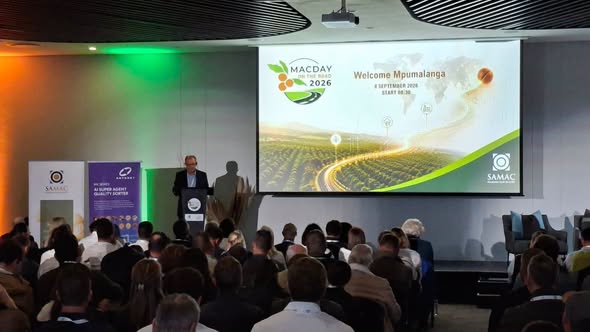

Macadamias South Africa (SAMAC) convened regional growers at the Premier Splendid Inn in Umhlanga for the KwaZulu-Natal leg of MacDay on the Road 2026. Designed to bridge macro-level international market dynamics with practical on-farm decisions, the event welcomed growers, agronomists, researchers, and Deputy Minister of Trade, Industry and Competition, Mr John Steenhuisen.
Industry Priorities Highlighted
SAMAC acknowledged the Deputy Minister’s address and highlighted key alignment points between government support and sector growth.
The primary focus areas included:
Enabling Environment: Removing regulatory and operational constraints for macadamia producers.
Market Access: Reducing tariff hurdles, specifically targeting high-growth destinations like India.
Market Diversification: Expanding global export footprints.
Value Addition: Boosting domestic processing capacity and product innovation.
Logistics: Upgrading export infrastructure to ensure efficient supply chains.
Inclusion: Fostering sustainable agricultural practices alongside sector transformation.
Government Focus on Fair Trade Competition
Speaking to regional growers, Deputy Minister Steenhuisen stressed that agricultural exporters face an increasingly complex international trading landscape marked by protectionism and supply-chain pressures.
He reaffirmed the government’s commitment to securing equal access:
“We are not asking for special favours… We want to be able to just compete on a fair and equal basis with our competitors around the world and then let our quality and our product speak for itself.”
Steenhuisen cited steep import duties in markets like India as target areas for trade negotiations, pledging that the Department of Trade, Industry and Competition (the dtic) will leverage bilateral trade networks to lower tariff barriers for South African produce.
Port Logistics and Export Efficiency
Addressing logistical challenges, the Deputy Minister identified port performance as a crucial driver of global competitiveness. He highlighted public-private partnerships at the Port of Durban as a practical vehicle to eliminate cargo delays, improve export throughput, and protect perishable shipments.
Strategic Roadmap for Sector Growth
Steenhuisen outlined five core pillars to steer public-private collaboration:
Productivity: Deploying precision farming, biological inputs, drone technology, and advanced breeding to lift farm yields.
Quality Control: Maintaining high food-safety and grading standards to safeguard South Africa’s global brand reputation.
Tariff Reforms: Opening new international trade corridors while negotiating reduced import taxes.
Local Processing: Maximizing value domestically through derivative products such as macadamia oil.
Inclusion: Expanding opportunities for new entrants and small-scale farmers.
Rooibos: How an Indigenous Crop Built a Global Agribusiness Heritage
Public-Private Collaboration
SAMAC welcomed the dtic’s commitment to an open-door policy, emphasizing its dedication to ongoing engagement on matters impacting competitiveness and sustainability. Both parties urged growers, processors, researchers, and investors to maintain active dialogue to ensure local production strength translates into long-term global success.