

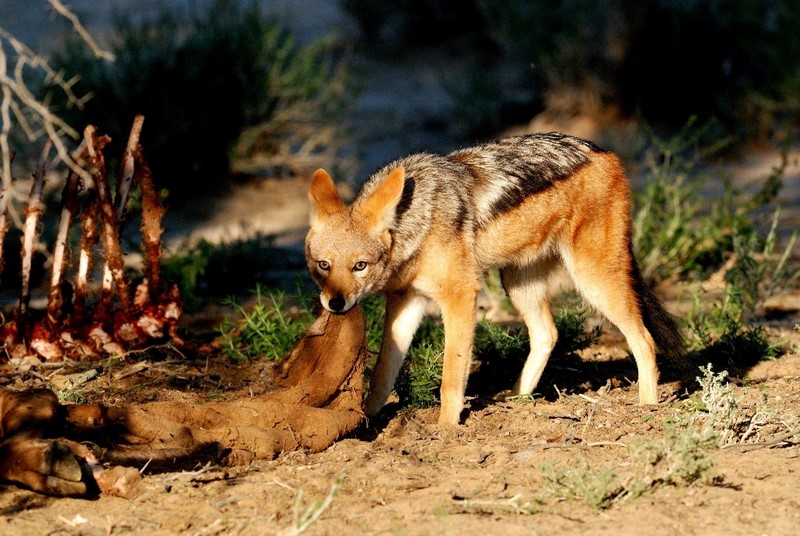

Stellenbosch University engineers have developed an automated, solar-powered biotelemetry system to track black-backed jackals, opening the door to smarter, non-lethal predator management for livestock farmers.
Black-backed jackals remain one of the most severe threats to South African livestock farming, particularly for small-scale subsistence and emerging farmers. Predation inflicts heavy financial losses and immense psychological stress on farming communities.
Traditional control methods—such as calling and shooting at night—have largely failed to curb the problem. Furthermore, ecologists warn that lethal culling disrupts jackal social structures, causing younger females to breed earlier and allowing outside packs to claim empty territory, ultimately increasing predation.
Now, innovative engineering offers a path toward understanding—and managing—these adaptable mesopredators through data rather than force.
Smart monitoring in low-coverage areas
Developed by Megan le Roux as part of her master’s degree in electronic engineering at Stellenbosch University’s Digital Signal Processing Laboratory, the new biotelemetry system remotely records jackal behaviour without human intervention.
Deploying sensor nodes to rural farms, the system overcomes common field challenges:
Automated Data Transfer: Unlike standard camera traps that require manual SD card retrieval, this system uses Passive Infrared (PIR) motion sensors to trigger 30-second video recordings, which automatically upload to a central Google Drive storage platform.
Low Network Connectivity: Only a single central access point requires an LTE (4G) connection, creating a local Wi-Fi network that allows remote nodes to operate deep in areas with poor cellular coverage.
Night-Vision & Solar Power: Nodes feature low-light cameras optimized for nocturnal tracking and individual solar-harvesting units, eliminating grid dependency and battery maintenance.
During a five-day field test, the automated system successfully captured and transmitted 709 video clips of 30 seconds each (1.3 GB of data) alongside environmental metrics like temperature and humidity—all without human presence disturbing the animals.
Why this matters to farmers
Black-backed jackal populations have surged across agricultural lands due to habitat loss and fewer natural apex predators. Because jackals adapt their breeding, hunting, and litter sizes directly to food availability, current management strategies are often playing catch-up.
By capturing continuous, real-time video of hunting, feeding, and breeding patterns, the system gives farmers and wildlife biologists the missing link: hard data on how jackals navigate agricultural landscapes.
In the long term, this video and environmental intelligence will support the development of ecologically sustainable, ethically sound, and genuinely effective management strategies—helping livestock producers protect their herds without triggering the ecological backlash of traditional culling.