


Following the activation of the historic dual national disaster classifications last week, the operational battle to restore the Western Cape’s multi-billion-rand agricultural network has reached a critical bottleneck. In a provincial update issued on May 24, Premier Alan Winde appealed for patience from residents and producers alike, revealing that while recovery mechanisms are moving swiftly, operations are fighting a double war against catastrophic infrastructure damage and active criminal sabotage.
For the province’s export-driven farming nodes, the logistical update is a mix of rapid engineering feats and agonizing delays.
Grid Restoration Hit by Rural Lawlessness
In the days following the initial mid-May storms, Eskom and municipal technical teams faced waterlogged fields and fallen pylons to repair over 9,000 faults. Provincial data now confirms that power has successfully been restored to 80% of affected customers.
However, a sinister new threat has emerged to slow down the remaining 20% of the grid recovery. Premier Winde strongly condemned escalating reports of equipment vandalism and cable theft in isolated areas, which are actively undermining technical efforts. For agricultural producers reliant on stable grids for packhouses, automated sorting, and cold storage chains, this lawlessness directly threatens the viability of harvested commodities.
Tracking the Rural Bottlenecks
The Provincial Disaster Management Centre (PDMC) has pinpointed exactly where the recovery of key agricultural corridors stands:
Cederberg & Matzikama Citrus Hubs: In Citrusdal, teams are currently replacing and restringing damaged poles and conductors, while construction in Lutzville is advancing well. Crucially for local fruit growers, repair work in the hard-hit Algeria region will remain frozen until operations in Citrusdal and Lutzville are entirely completed.
Cape Winelands: Repairs to the high-voltage main line between Boskloof and Romansrivier are progressing. However, a dense backlog of localized faults persists across primary wine and fruit nodes in Chavonnes, Hexrivier, Rawsonville, and the greater Witzenberg area.
Overberg & Garden Route: Grid recovery operations remain slow but ongoing across fruit and dairy farms in Elgin, Papiesvlei, Stanford, and Blanco farms.
The 160-Road Freight Crisis
While the macro funding unlocked by the National Disaster Management Centre (NDMC) is earmarked for long-term transport pathway rehabilitation, immediate freight transport remains heavily compromised.
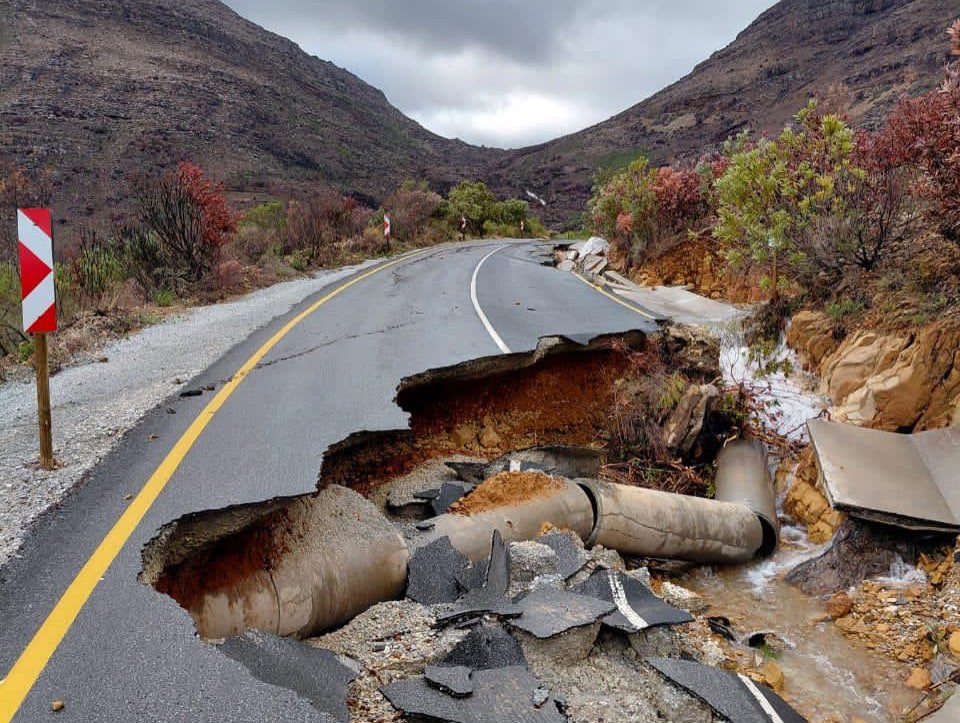
Out of 400 roads across the province structurally compromised by the successive weather fronts, just over 60% have been repaired and reopened. For agricultural logistics, this means nearly 40%—roughly 160 rural and regional roads—remain completely closed or unsafe for heavy freight. This persistent bottleneck continues to choke the movement of fresh produce, livestock, and essential inputs toward the Port of Cape Town.
As the province transitions from emergency damage logging to active physical rebuilding, the Premier’s call for patience underscores the sheer scale of the devastation. With national funding mechanisms now legally operational, the agricultural sector’s survival through this consecutive disaster depends entirely on how quickly teams can overcome rural sabotage and patch the broken veins of the province’s transport network.