


On 28 January 2025, Nedbank Agriculture hosted a roundtable event to reflect on the challenges of 2024 and explore what lies ahead for the sector in 2025. Experts from across the industry, including economist Wandile Sihlobo, agricultural meteorologist Johan van den Berg, and market analyst Tracy Davids, shared insights on the economy, climate, and global trade.
Nedbank’s View: Preparing for the Future
Opening the event, Zhanne Meyer, head of agricultural finance at Nedbank CIB, acknowledged that 2024 was a tough year for agriculture and finance. “Demand for credit has been down—it’s been a year of consolidation and caution,” he said. However, he highlighted the importance of climate-smart agriculture and how innovative financing models can help farmers across Africa.
John Hudson, head of agriculture at Nedbank South Africa, emphasized the need to manage volatility and prepare for uncertainty. “We are moving away from traditional balance sheet models to income statement-focused solutions,” he explained. Weather-based index insurance and the virtual farmer program are some of the new financial tools Nedbank is developing to help farmers navigate risk.
2024 in Review: A Tough Year for Farmers
Tracy Davids, executive director at the Bureau for Food and Agricultural Policy, provided an overview of 2024’s agricultural performance. The sector struggled with drought, high feed costs, and economic pressures, leading to a contraction in GDP, though the full impact is still being assessed.
While grain and oilseed farmers faced losses, the horticulture industry performed well, with strong fruit exports due to global demand. However, logistical inefficiencies at South African ports cost the industry over R1 billion, highlighting the ongoing challenges in infrastructure.
The livestock sector showed signs of recovery, with poultry bouncing back from the 2023 bird flu outbreak and beef exports increasing by 16 percent. Egg prices remained high due to supply constraints, but overall, the sector was on a positive trajectory.
Looking ahead to 2025, a 3 percent growth in agriculture is possible, but risks remain. As Davids explained, agriculture is more volatile than other sectors, but historically, it has outperformed total GDP growth over the past 20 years.
Weather: The Growing Uncertainty
Johan van den Berg, an agricultural meteorologist, warned that climate variability is becoming a bigger challenge for farmers. Some areas experienced record-low temperatures in August, while others saw extreme heatwaves in October. Rainfall was inconsistent, making it difficult for farmers to plan their planting and irrigation schedules. Van den Berg cautioned that a long-term drier cycle may have already started and could worsen by 2026. Farmers must take proactive measures to mitigate risks by diversifying crops, investing in irrigation technology, using weather monitoring tools, and adjusting livestock management practices to deal with heat stress.
Global Trade and Policy: Risks and Opportunities
Wandile Sihlobo, chief economist at Agbiz, outlined the economic factors shaping agriculture in 2025. The sector is poised for recovery, supported by improved rainfall, stable electricity, and better disease control. However, global trade dynamics present new risks.
Protectionist policies in the European Union could make it harder for South African exports to remain competitive. The uncertainty around potential US tariffs on China may also disrupt global grain markets, affecting prices and trade flows. On the other hand, the expansion of BRICS offers new opportunities for South African agricultural exports, particularly in maize, beef, and wheat.
Domestically, progress in land reform could unlock 2.5 million hectares of underutilized farmland, but infrastructure issues such as poor roads and inefficient ports remain a major concern.
Farmers should focus on diversifying export markets, adopting climate-smart agriculture, and staying informed on policy changes. Reducing dependence on traditional markets like the US and EU, improving water management strategies, and investing in modern farming technologies will be critical in managing risks and ensuring long-term sustainability.
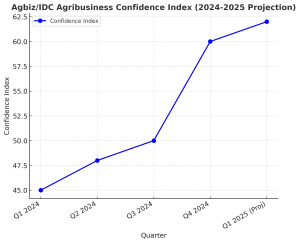
The Agbiz/IDC Agribusiness Confidence Index, which increased in Q4 2024, reflects renewed optimism in the sector as conditions improve.
Adapting to a Changing World
The Nedbank Agriculture Roundtable highlighted that while the future is uncertain, farmers who manage volatility, embrace innovation, and stay ahead of global trends will be in a strong position to succeed. By focusing on the factors they can control, South African farmers can turn 2025’s challenges into new opportunities.