

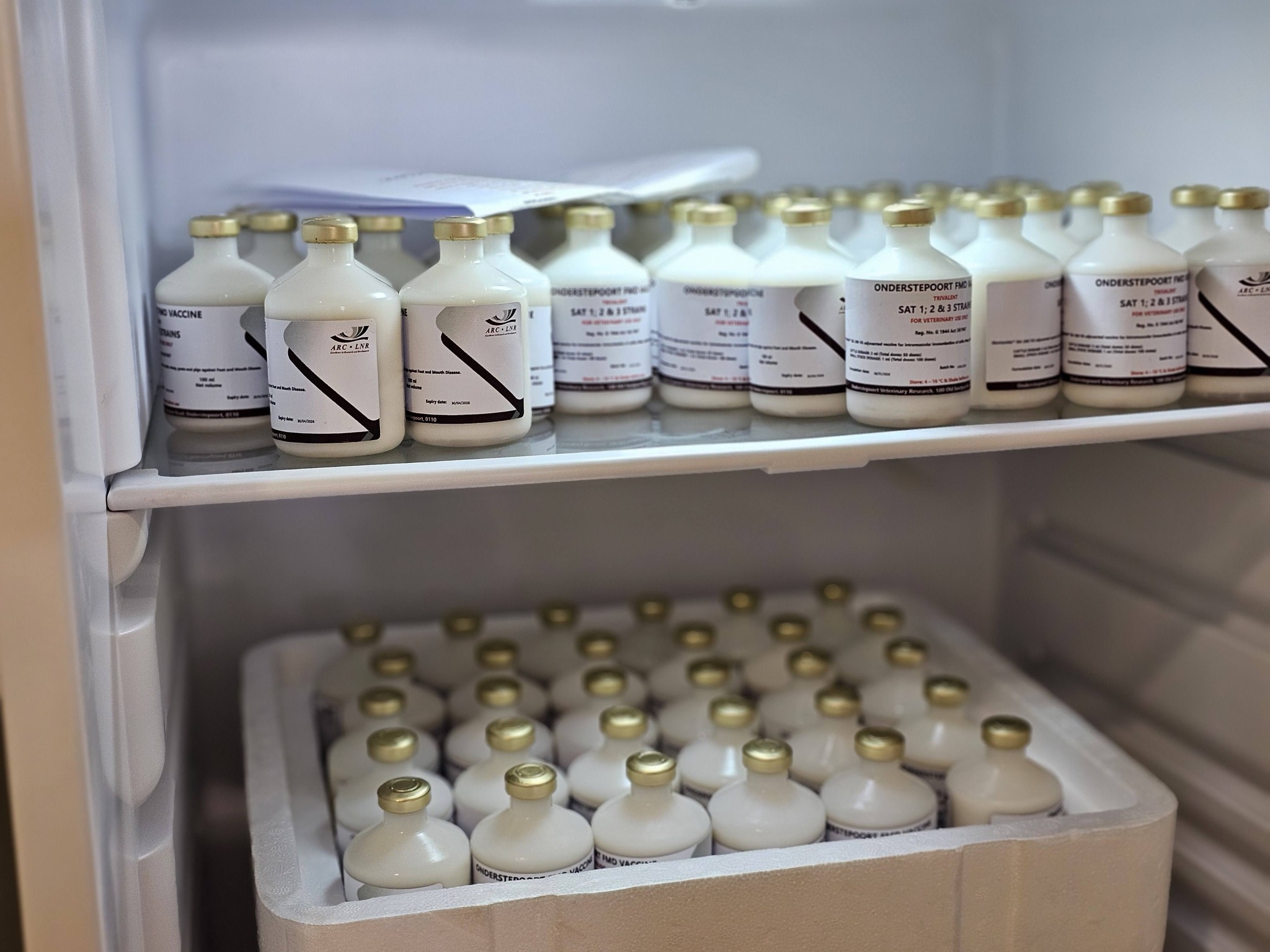

The announcement on 6 February 2026, by Agriculture Minister John Steenhuisen regarding the local production of Foot-and-Mouth Disease (FMD) vaccines at the Agricultural Research Council (ARC) has sent ripples through the South African livestock industry. For the first time in two decades, South Africa has produced its own FMD vaccine batch, signaling a strategic shift toward “vaccine sovereignty.”
The Return of Local Production
The initial pilot batch of 12,900 doses was produced using modern bioreactor technology specifically designed to match the SAT 1, 2, and 3 strains prevalent in the region. The government’s roadmap is ambitious: the ARC expects to ramp up to 20,000 doses per week by March 2026, with a long-term goal of reaching 200,000 doses per week by 2027.
For a country that has been at the mercy of expensive imports and fragile international supply chains, this move is a necessary step to reclaiming South Africa’s FMD-free status from the World Organisation for Animal Health (WOAH). However, this scientific victory is being launched into a landscape of unprecedented veterinary challenge.
Escalating Outbreaks: A Nation Under Pressure
The “breakthrough” announcement comes at a time of severe escalation across the country. As of early February 2026, the situation has shifted from chronic to acute in several key regions:
KwaZulu-Natal: Currently the national epicenter, official reports confirm over 207 outbreaks, with 187 remaining unresolved. With a cattle population of 2.4 million, the impact is being described by provincial authorities as a “crisis of social and economic dimensions.”
Western Cape: Following a period of relative safety, FMD was officially confirmed in Mbekweni (Wellington) on Friday, February 6. Suspected cases are currently being inspected in George, Mossel Bay, and the Garden Route. The provincial government has moved to allocate R100 million for emergency vaccine procurement and roadblocks.
Gauteng and Free State: Major feedlots and dairy operations have reported new cases within the last week, highlighting the virus’s ability to penetrate high-security biosecurity zones.
The Reality on the Ground
While the industry has welcomed the restart of local production, technical consultants have noted that the initial rollout will require a phased approach. Veterinary specialists have emphasized that the current scale of production is an important pilot phase that will need significant expansion to cover the national herd.
The expert critique focuses on three critical areas:
-
Logistical Coordination (instead of Logistical Deadlock)
-
Infrastructure Development (instead of Infrastructure Skepticism)
-
Phased Implementation (instead of Economic Impatience)
“The consensus within the sector is that the ARC has proven its capability to produce a high-quality vaccine, marking a long-term strategic win for South African biosecurity. While the immediate situation in the Western Cape, North West, Free State, and KwaZulu-Natal requires continued vigilance and the use of imported supplies to bridge the gap, the industry now has a sustainable, home-grown foundation to build upon.”