

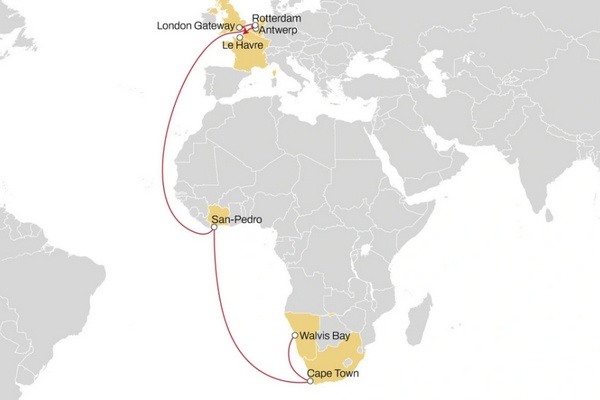

As the 2026 harvest reaches its crescendo, the logistics landscape has shifted to provide a massive boost for South African agriculture. Through a dedicated “speed-to-market” strategy, Mediterranean Shipping Company (MSC) has temporarily rebranded its service to the Western Cape Express, cutting critical days off transit times to Europe’s most lucrative retail markets.
The initiative officially kicked off when the first vessel, the MSC TANIA (voyage WM601R), departed Cape Town on 2 January 2026. After a swift journey across the Atlantic, the vessel is currently expected to dock at London Gateway tomorrow, 24 January 2026, marking a successful maiden run for this seasonal express route.
The Race Against the Clock
For table grapes and nectarines, the clock starts ticking the second they are harvested. While South African producers lead the world in post-harvest cooling technology, even the most sophisticated “cold chain” cannot stop the biological clock of fresh produce. Every day spent at sea is a day lost on a supermarket shelf.
By replacing the traditional Gqeberha call with a direct Cape Town departure during this peak window, the industry is prioritising velocity. This isn’t just a minor schedule tweak; it is a strategic preservation of product integrity for fruits that demand rapid delivery.
The 22-Day Advantage: The New Port Rotation
The success of this “speed-to-market” strategy lies in a simplified, Northbound port rotation. By stripping away secondary stops and prioritising the Western Cape’s exit point, MSC has created a high-speed “green lane” for perishable goods.
The updated seasonal rotation includes:
-
Walvis Bay: Initial regional collection.
-
Cape Town: The primary export hub and final South African exit.
-
San Pedro: A strategic mid-transit call in Côte d’Ivoire.
-
London Gateway: The first European entry point (Direct UK access).
-
Rotterdam: Primary gateway for the Netherlands and Germany.
-
Antwerp: Key terminal for the Belgian and French markets.
-
Le Havre: Final European discharge point.
This specific sequence allowed the MSC TANIA to bridge the gap between Cape Town and London in just 22 days. For shipments continuing to the continent, the vessel is expected to reach Rotterdam and Antwerp by January 26th.
Maximizing Quality and Shelf Life
Faster transit does more than just get fruit to stores quickly; it reduces the window of risk. By shortening the duration that “reefer” (refrigerated) containers are at sea, the cumulative stress on the fruit—often caused by minor temperature fluctuations—is significantly lowered. This ensures that when the MSC TANIA unloads tomorrow, the stone fruit and grapes maintain the firmness and flavour profile that European consumers demand.
A Seasonal Strategic Pivot
This operational shift is a direct response to the peak export window for Western Cape produce. MSC has configured the service specifically for temperature-controlled cargo, acknowledging that for the 2026 season, “reliability” is synonymous with “speed.”
Exporters should remain mindful that this is a seasonal arrangement. By March 2026, the service is expected to revert to its standard routing. For the next few weeks, however, the Western Cape Express remains the fastest conveyor belt for South Africa’s agricultural “gold” to reach the North West Continent.