

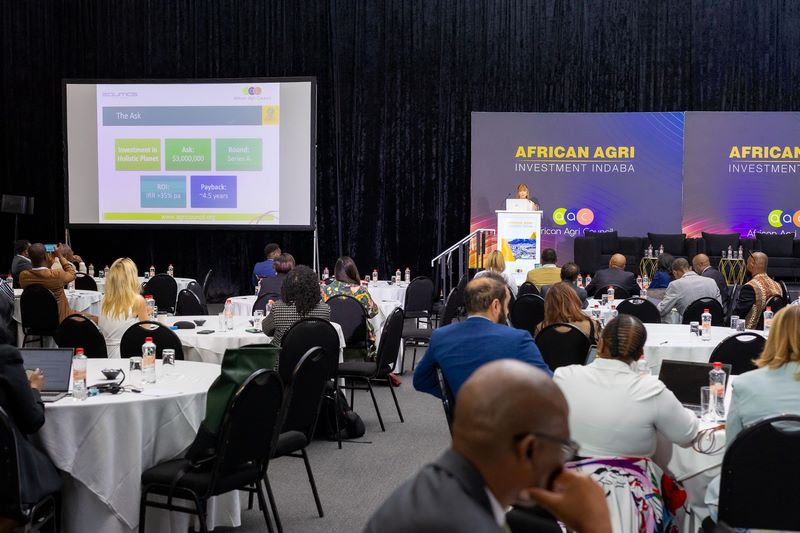

The African Agri Investment Indaba 2025, held in Cape Town from 24 – 16 November 2025 decisively shifted the continental agri-food narrative from simply identifying challenges to architecting actionable, integrated solutions. Attracting 59 active investors and high-level political and business leaders, the Indaba provided a clear blueprint for transforming Africa’s agri-food systems toward self-sufficiency and global competitiveness.
Capital Aligns with Innovation: The Investment Momentum
The event’s initial momentum was centred on the rapid alignment between strategic capital and high-potential projects. The “Seeds & Startups” track, powered by curated Investment Discovery Sessions (IDS), served as the epicentre for deal flow. The African Agri Council reported a robust pipeline of engagement, successfully bridging the gap between innovators and the necessary funding. Investment opportunities spanned critical, high-growth sectors, confirming investor appetites for ventures focused on:
-
Agri-tech & Fintech: Digital solutions essential for supply chain efficiency and farmer payment systems.
-
Agro-processing & Value Addition: Projects that transform raw produce into higher-value goods, creating jobs and reducing post-harvest losses.
-
Sustainable Agriculture: Climate-smart and regenerative models that ensure long-term productivity and resilience.
Logistics: The Missing Link for Regional Trade
A central, unifying theme of the Indaba was the critical role of robust logistics and functional trade corridors in unlocking Africa’s agricultural potential. High-level speakers, including H.E. Olusegun Obasanjo and The Honourable Thoko Didiza, underscored that policy must prioritise infrastructure. Data presented confirmed that intra-African agri-food trade remains low (16-18%) largely due to inefficient logistics, not a lack of agricultural capacity.
Experts argued that fixing the “logistics bottleneck” is a prerequisite for global competitiveness. Case studies, like the Lobito Corridor, demonstrated how targeted infrastructure investment could significantly reduce transport costs, cut losses, and make agribusiness viable, transforming local production into export-oriented value chains.
Scaling Protein and Building Resilience
The final day focused on “Walk-the-Talk” solutions, entering on climate-smart agriculture (CSA) and food security. A crucial session on Securing Africa’s Protein Future highlighted the need to develop efficient, inclusive poultry and broader agricultural value chains, citing this as fundamental to reducing reliance on imported protein.
Furthermore, sessions on Innovative Financing for Climate-Smart Agriculture moved beyond theoretical discussions, showcasing successful blended finance models that de-risk investment and incentivise the adoption of CSA technologies. Leaders mapped out actionable pathways to feed the continent, emphasising that scalable, localised solutions—supported by appropriate technology and inclusive of small and medium-sized enterprises (SMEs)—are key to a holistically resilient and self-sufficient future.
The Indaba concluded with the prestigious Agri Investment Indaba Awards, celebrating the individuals and companies who have made significant, measurable strides in sustainable and impactful African agriculture.