

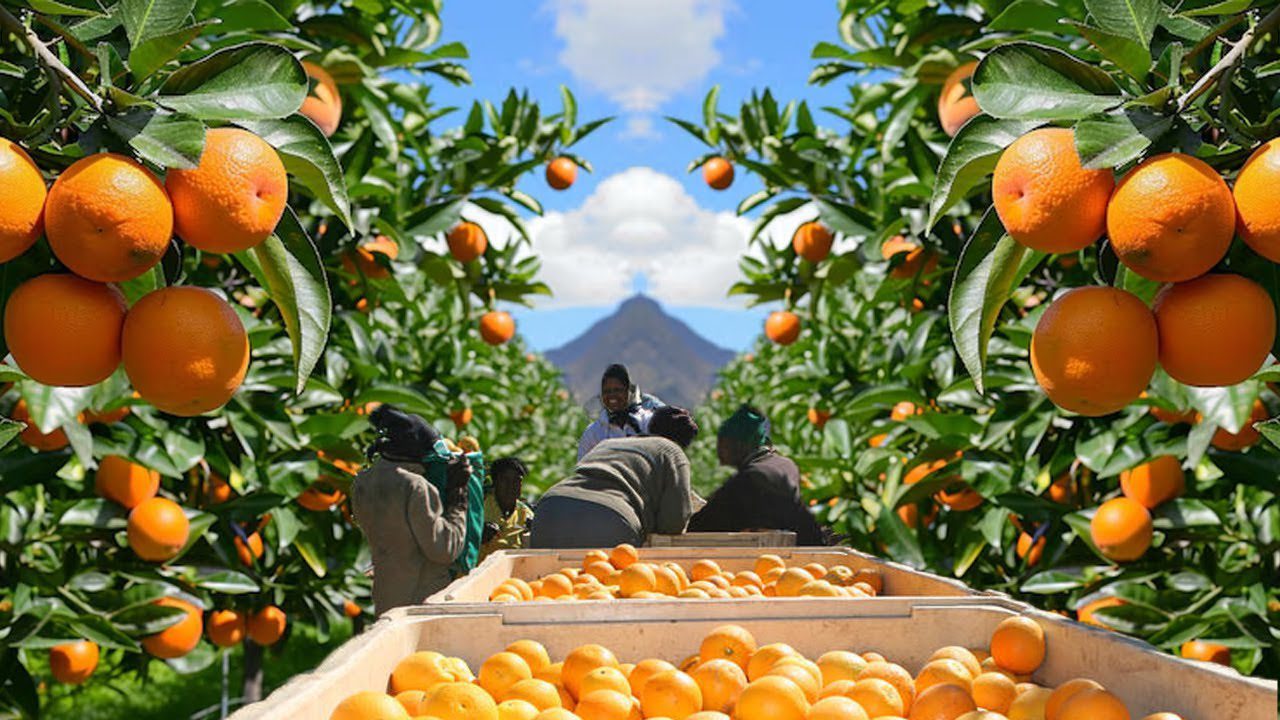

For years, the South African citrus industry has been chasing the horizon. This week, it finally crossed it. With 2.9 million tons exported in 2025, South Africa has officially unseated Spain as the world’s top citrus exporter by volume. However, while the Citrus Growers’ Association (CGA) has reason to celebrate this massive output, the achievement is tempered by the immediate pressure of logistical constraints and recent climatic challenges; the crown is heavy, and the “logistics ledger” is yet to be balanced.
The Volume Victory
National Minister of Agriculture John Steenhuisen championed this milestone as a defining moment for national resilience. “To overtake a citrus export giant like Spain, even by a small margin, is no easy feat,” Steenhuisen remarked, noting that South Africa’s reputation for world-class quality and strict compliance with international plant health standards has finally tipped the scales.
Yet, Steenhuisen offered a crucial distinction that separates market dominance from sheer output. While South Africa leads in export volume, giants like Brazil and China still dwarf our total production, albeit for their own domestic consumption. South Africa’s success is a triumph of “export-focused” strategy—a model that has turned the sector into a R44.9 billion ($2.47 billion) cornerstone of the agricultural economy.
The Provincial Engine and the Growth Strategy
From the Western Cape, Minister Dr. Ivan Meyer—whose portfolio spans Agriculture, Economic Development, and Tourism—highlighted the regional pulse behind the national numbers. Meyer pointed to the provincial “Growth for Jobs” strategy as the silent partner in this success, framing citrus not just as a farming achievement, but as a critical economic pillar.
“This achievement reflects years of sustained investment and a relentless focus on quality,” Meyer noted, emphasizing that the Western Cape remains the vanguard for meeting the rigorous international standards that allow South African fruit to command global shelf space. He further emphasized that this milestone is about more than just numbers; it is about livelihoods. “The sector supports thousands of jobs and sustains livelihoods in many of our rural communities,” he added.
The “Sihlobo Synthesis”: Value vs. Volume
While politicians celebrate the “No. 1” ranking, Agbiz Chief Economist Wandile Sihlobo provides the necessary economic nuance. Sihlobo’s analysis suggests that while we have won the volume race, the “value race” remains a steeper climb. Spain benefits from proximity to Europe—a luxury South Africa pays for in massive logistics costs and shipping “friction.”
Sihlobo has been vocal about the “double-edged sword” of 2026. While the industry targets a staggering 210–215 million cartons this season, the infrastructure to move it is under siege. The recent floods in the Western and Eastern Cape, which have placed parts of the industry under a National State of Disaster, serve as a reminder that production is only half the battle. As Sihlobo has aptly noted, this success is a “miracle of the private sector,” often occurring despite state-run rail and port inefficiencies.
The Road to 260 Million
The consensus among Steenhuisen, Meyer, and the CGA is that the current record is merely a pitstop on the road to “Vision 260″—the industry’s goal of 260 million cartons by 2032.
To get there, the narrative must shift toward the “intensified diplomacy” Steenhuisen mentioned. The recent breakthrough in Chinese export protocols is the template for the future. South Africa is no longer just a Southern Hemisphere player; it is the global anchor of the citrus trade. But as the experts warn, staying at the top will require a radical overhaul of the ports to ensure that the No. 1 spot translates into sustainable, long-term profitability.